As someone who has travelled far and wide, I have seen more than my fair share of bizarre signs that have given me cause to raise an eyebrow or left me tittering and giggling like a daft schoolboy. It might be the name of a business or a product that is completely acceptable in the source language but, for English speakers, has a different meaning, often with sexual undertones. Or it could be a notice that is supposed to give special instructions about something, but, because it has been so badly translated, it is little more than nonsensical innuendo-riddled mumbo jumbo. Thankfully, I used to take pictures of anything that tickled my fancy and in this post I’ve cobbled together some of my favourites. Although most of them are quite humorous, I’ve also included one or two serious signs just because I think they’re interesting in their own little way. You will also notice that a couple of the signs are not signs at all – they are objects – but, due to their titillating qualities, I thought I’d include them anyway!
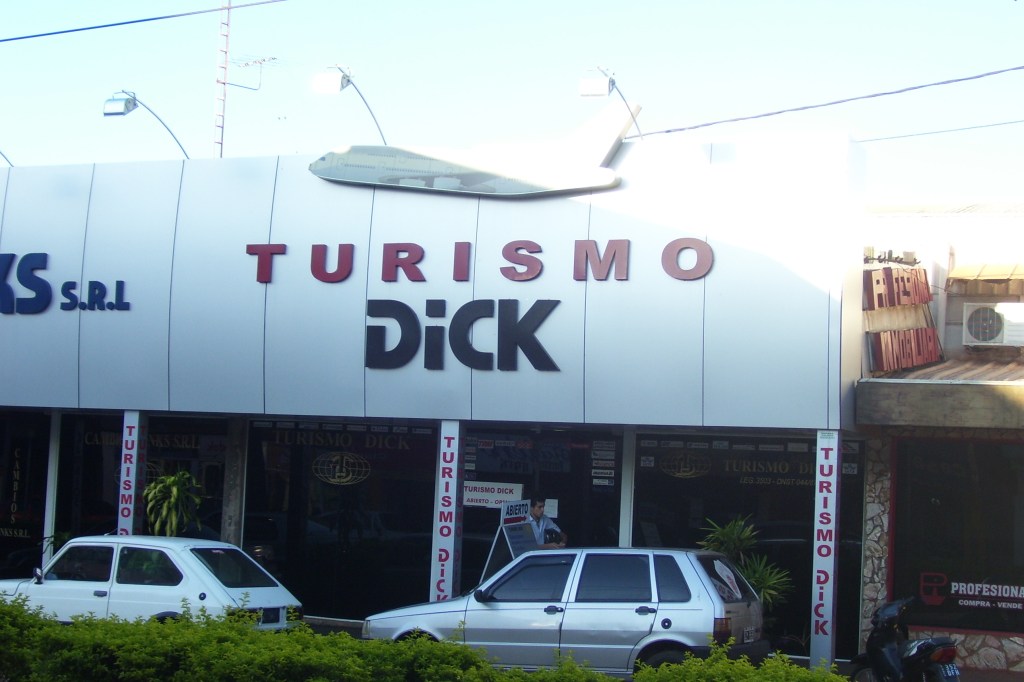
Here’s a nice dick pic to start us off. It was taken in Missiones, Argentina, whilst visiting Iguazu Falls. I imagine it is quite acceptable to name your business ‘Turismo Dick’ in a country where Spanish is the language spoken. Unfortunately, however, this is not the case in the English-speaking world. ‘Dick’ – the shortened version of the name Richard – is a moniker widely used to refer to the male reproductive organ. You could be forgiven for believing, therefore, that this business might promote the kind of tourism popular with women or, in some cases, men who might be looking for a bit of a ‘sausage fest’ on their holidays.

The splendidly named Phousi (think of the film ‘Goldfinger’ and how Sean Connery’s James Bond pronounces the pussy in Pussy Galore) Hotel was spotted whilst visiting Vang Viang in Laos. I have no idea if it means anything in Lao but, in the English-speaking world, ‘pussy’ is not only an affectionate term used to refer to a cute little cat, but is also a vulgar way to make reference to the female reproductive body part. This may lead you to conclude, therefore, that the hotel’s main attraction is quite the opposite to the kind of thing the clientele of ‘Turismo Dick’ are on the hunt for.
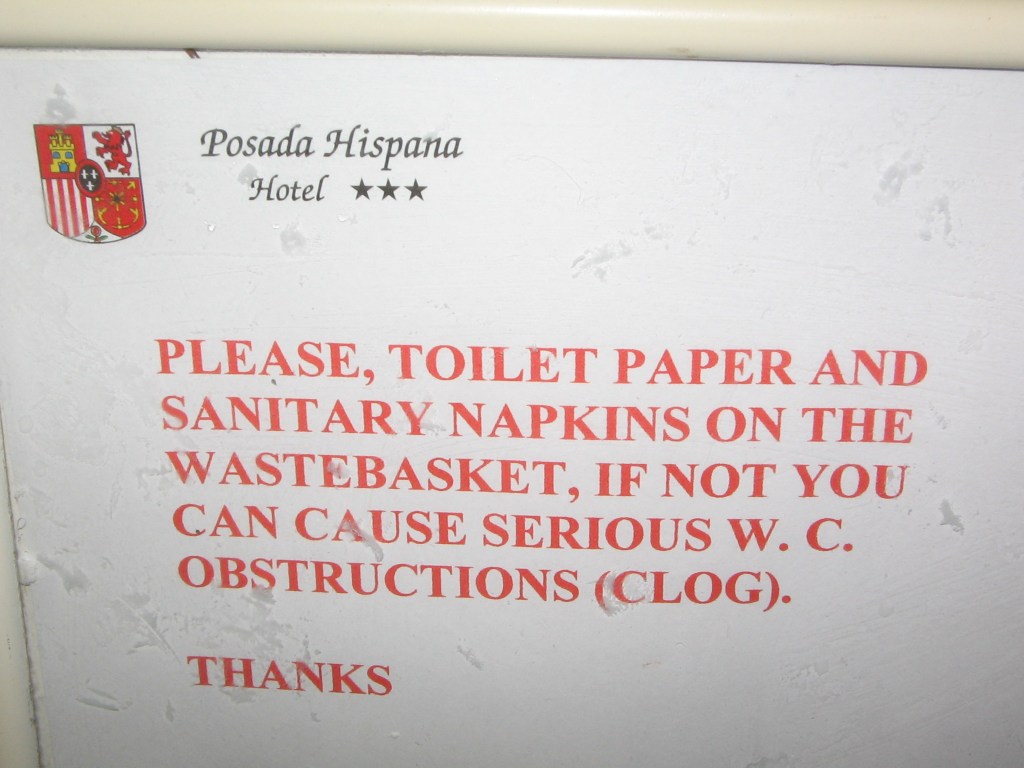
I discovered this notice in a hotel in Pisco, Peru. At the time, I couldn’t help but feel that the wordsmith responsible for crafting such a text hadn’t really managed to capture the English language in all its glory. I’m certainly no William Shakespeare, but if I was asked to improve it, I would probably go with the following: ‘Please put toilet paper and sanitary towels in the waste bin to avoid blocking the toilet. Thank you.’


I discovered this fine establishment whilst attending a Full Moon Party on the island of Ko Phangan in Thailand. At first glance, it appears that the name of this business is ‘Porn Pharmacy’ which might lead you to believe that it is the kind of joint where you can not only obtain headache tablets and cough mixture, but also ‘a bit of blue’ for the long night ahead. Indeed, it’s not until you swipe to the second picture that it dawns on you that your initial judgment was incorrect. It turns out this place is actually a ‘Nopporn Pharmacy’ – a pharmacy that has no porn – so basically it’s just a bog-standard pharmacy. Although this may cause disappointment for many, you’ve got to give full marks to the photographer who, by skilfully omitting those crucial three letters in the first photo, has optically created a wonderland for frisky hypochondriacs.
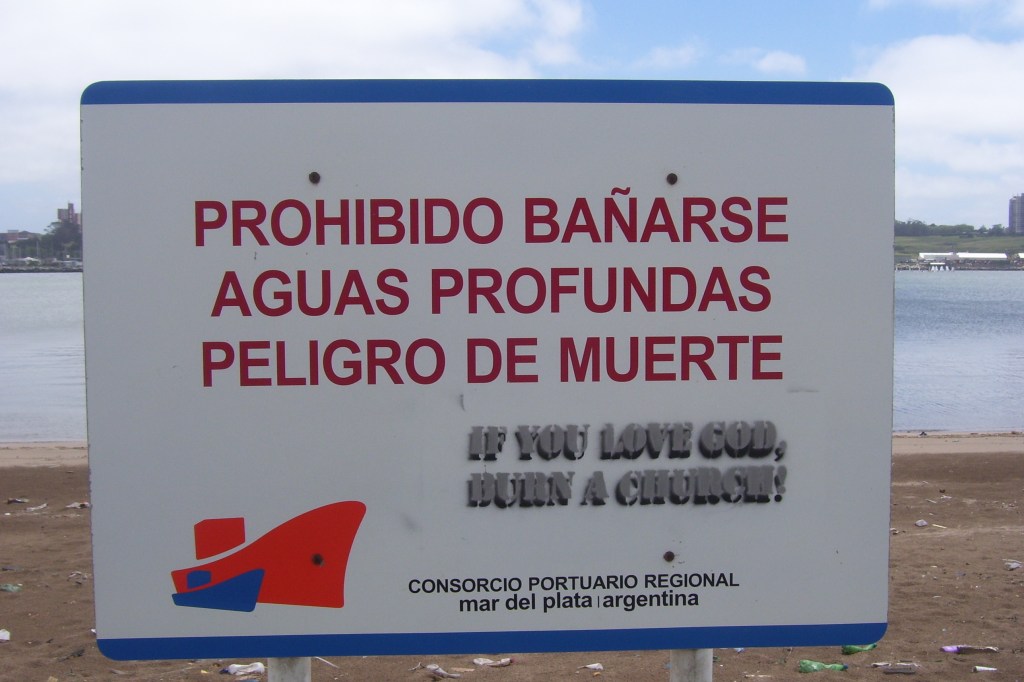
I spotted this sign during a walk along the harbour area in Mar Del Plata, Argentina. Whilst there is nothing strange about the sign itself, which simply warns people not to go for a swim in the deep water, it is the paradoxical nature of the graffiti sprayed on it that caught my eye. ‘If you love God, burn a church’ perfectly blends humour with absurdity and gave me quite a chuckle at the time. However, I later discovered that this provocative statement was originally written by the American singer Jello Biafra to challenge conventional beliefs and question the notion of religious devotion. It suggests that true love for God goes beyond traditional religious structures and rituals, urging individuals to engage with their faith in a more unconventional and personal way. By encouraging the burning of a church, the quote symbolically encourages individuals to break free from the confines of religious institutions and connect with their spirituality on a deeper level. Fingers crossed that everyone who read the quote in Mar Del Plata recognised it as metaphorical rather than a literal instruction!
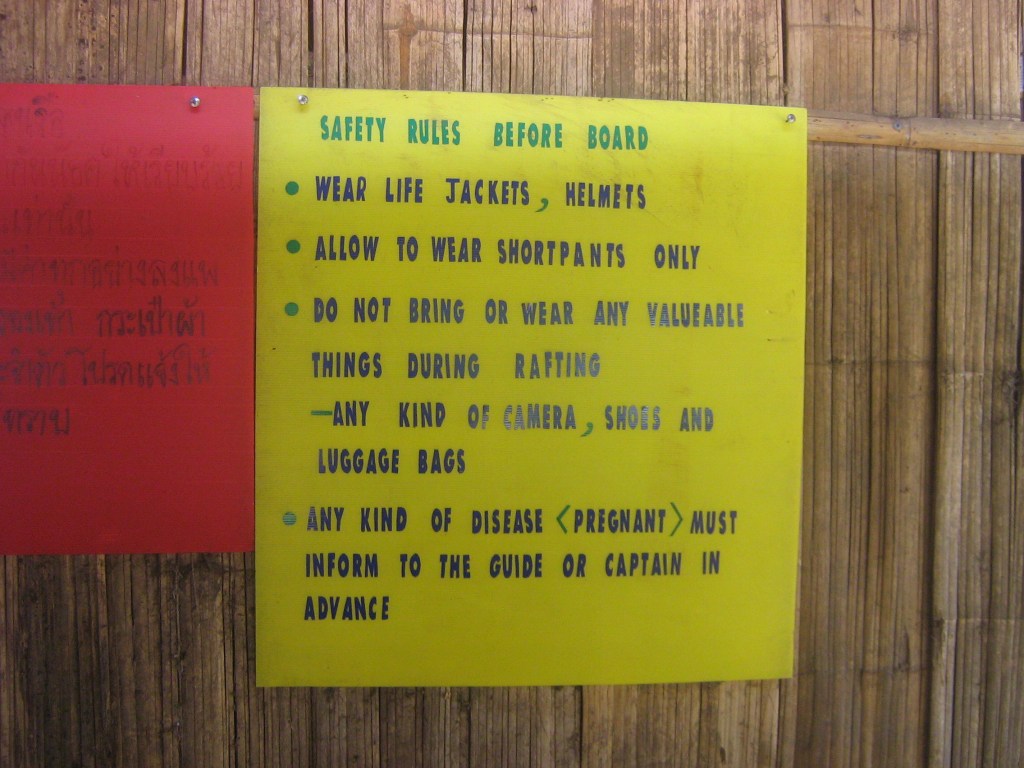
I spotted this sign in the jungle in Chaing Mai, Thailand, just before going white water rafting. Although peppered with very dodgy English, you can still more or less work out what it is trying to say. This doesn’t detract, however, from the fact it has probably been written by someone who believes they have mastered the English language just because they have watched a few episodes of Peaky Blinders on Netflix. It’s a bit of a dog’s dinner and the fact that being pregnant is somehow being alluded to as a disease, doesn’t help much either. I’m no Geoffrey Chaucer but if I was asked to come up with something better, I’d go with something like: ‘Safety Instructions – Wear life jackets and helmets on the raft – Wear shorts only (no long trousers/jeans allowed) – Do not bring any valuables on the raft including cameras, shoes or bags – Please notify us in advance if you have any medical conditions or if you are pregnant’.
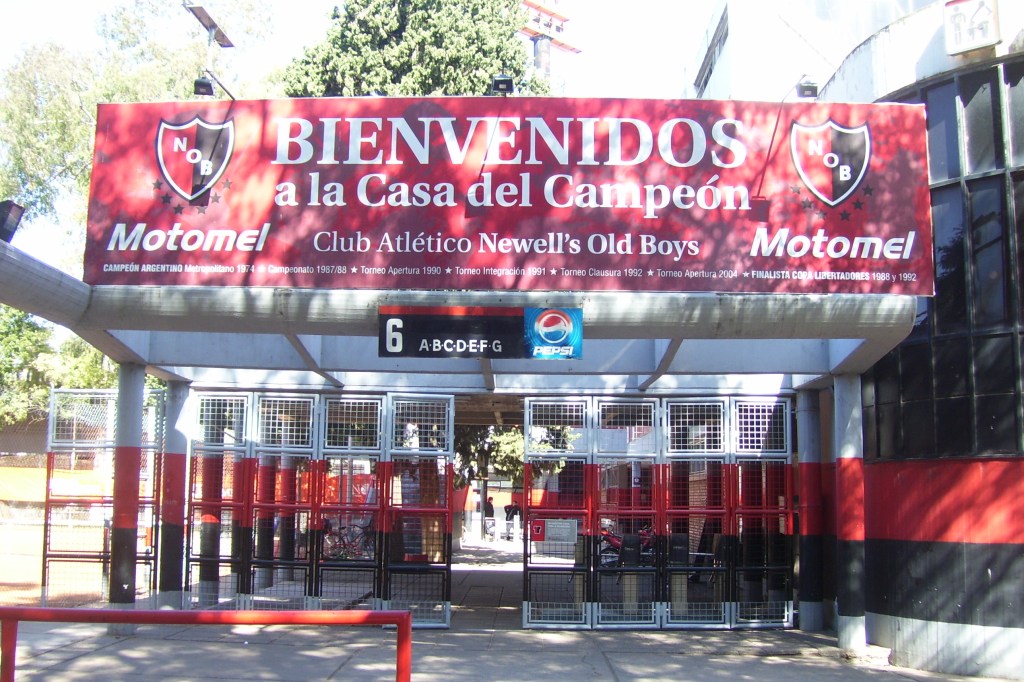
This photo was taken whilst visiting the stadium of Newell’s Old Boys in Rosario, Argentina. There is nothing strange about the actual sign but if you look at the top left and top right you will notice that the initials on the badge of this famous football club spell out ‘NOB’. Although this means nothing in particular in the Spanish-speaking world, in the UK, this is not the case. A ‘nob’ – often spelt knob – is another name commonly used to refer to a man’s penis and it can also be used as a way to address someone that you think is very stupid or unpleasant, as in ‘He’s a bit of a (k)nob’. This makes it quite an unfortunate name for the fans of Newell’s Old Boys who, in English terms, could be mistaken for being a bunch of NOBs.
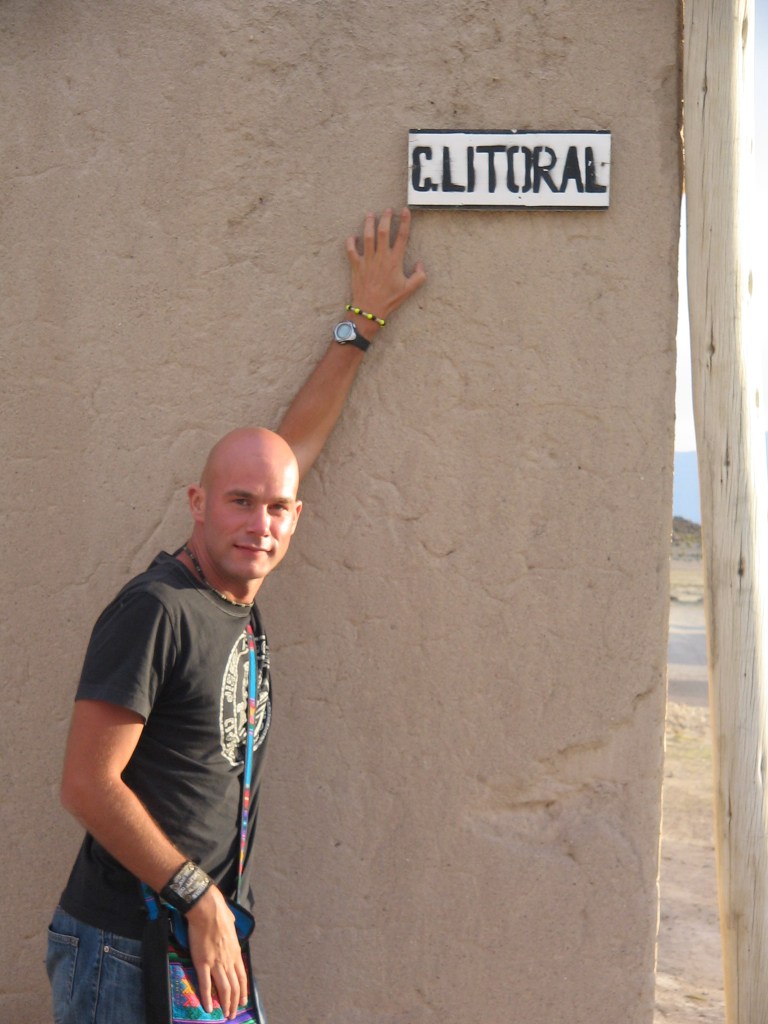
This intriguing road sign was taken in Uyuni, Bolivia. Although nobody would bat an eyelid about it in the Spanish-speaking world, nothing could be further from the truth for English speakers. Since the word ‘clitoral’ is an adjective ‘relating to or affecting the clitoris’, it means that it’s not really the ideal name for a road, or anything else for that matter. I’m sure you can imagine my reaction when I suddenly spotted it whilst walking round a semi-deserted village in the middle of nowhere. At the time, I couldn’t speak any Spanish and I just thought someone had randomly written ‘clitoral’ on a sign and nailed it to a wall. It wasn’t until later, when someone explained it to me, that I realised the name of the street was ‘Litoral’ and a ‘c’ – the abbreviated form of ‘calle’ which is Spanish for street – had been placed before it so this is why the full sign read ‘C.LITORAL’. To this day, it is still my favourite street name!
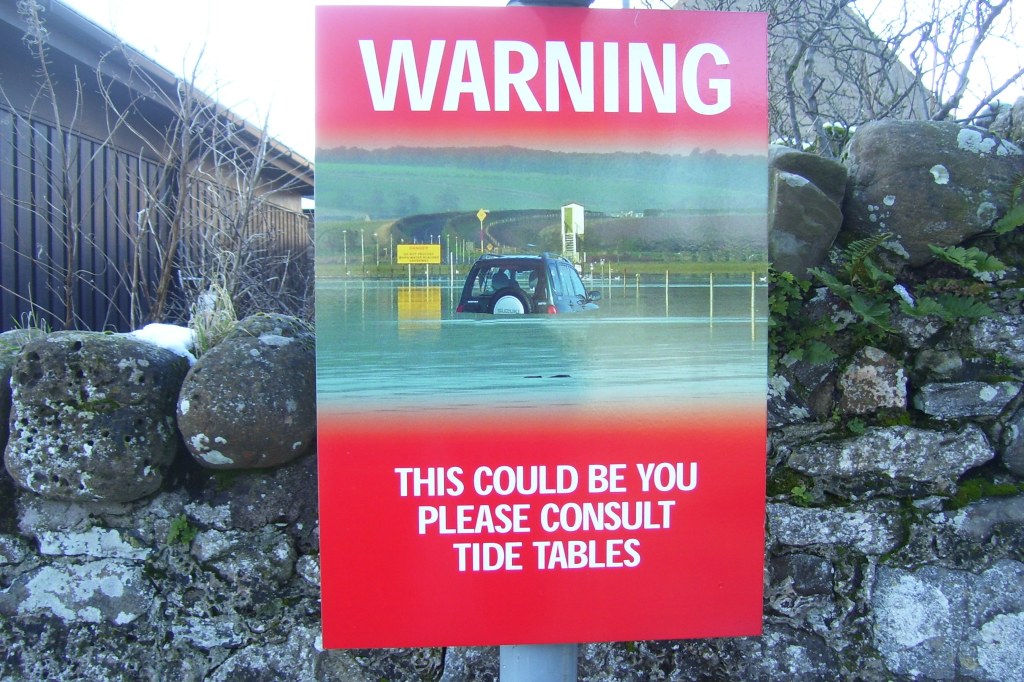
Here’s a sign I noticed whilst visiting Lindisfarne, also known as Holy Island, in the north of England. It’s a warning sign to tell people to check tide times before driving across the causeway. Every day, when the tide comes in, the road becomes submerged by the sea, blocking the route from the island back to the mainland. Timetables provide information when it is safe to cross so you can easily work out the latest time to depart. However, every year, there are cases of people who ignore the danger and make the crossing back to the mainland when it is not safe to do so. In the sign, you can see how a vehicle has become trapped by the rising sea, a calamity that could have been averted had the driver taken notice of the tide times.
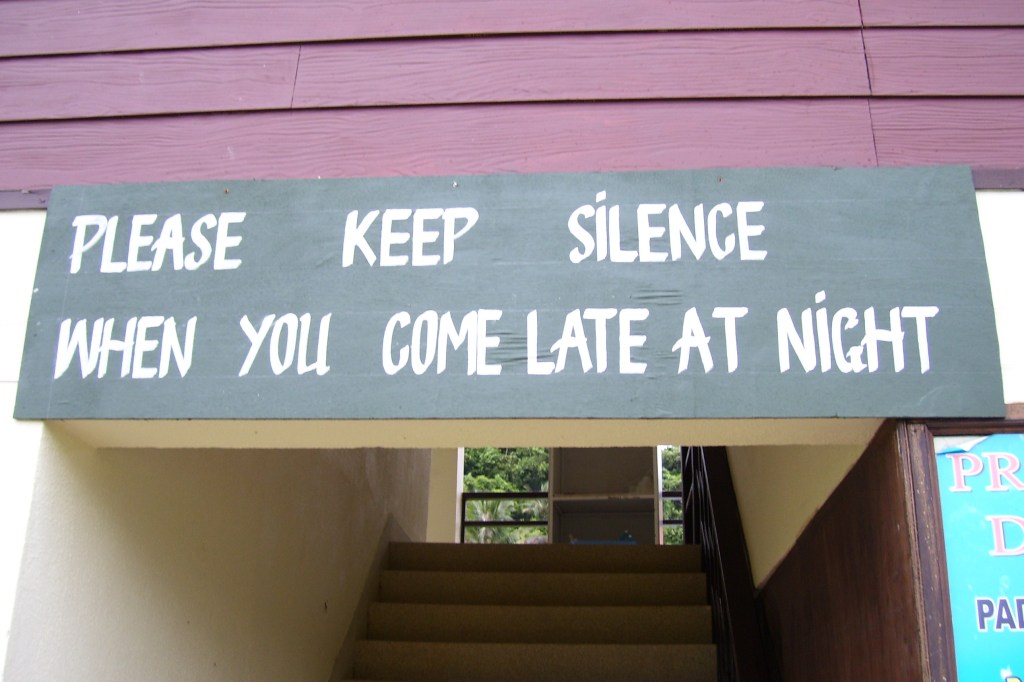
This amusing sign was found above the entrance to a hostel I stayed at in Ko Samui, Thailand. As far as I’m concerned, it can often be a challenge to ‘keep silence when you come late at night’, or even during the day for that matter. Due to its sexual connotations related to reaching orgasm, the decision to use the word ‘come’ is an unfortunate choice by the hapless individual who has put this together. Had the phrasal verb ‘come back’ – as in ‘return’ – been employed instead, such ambiguities would have disappeared. Therefore, a much more appropriate sign might read: ‘If you come back late at night, please be quiet’.
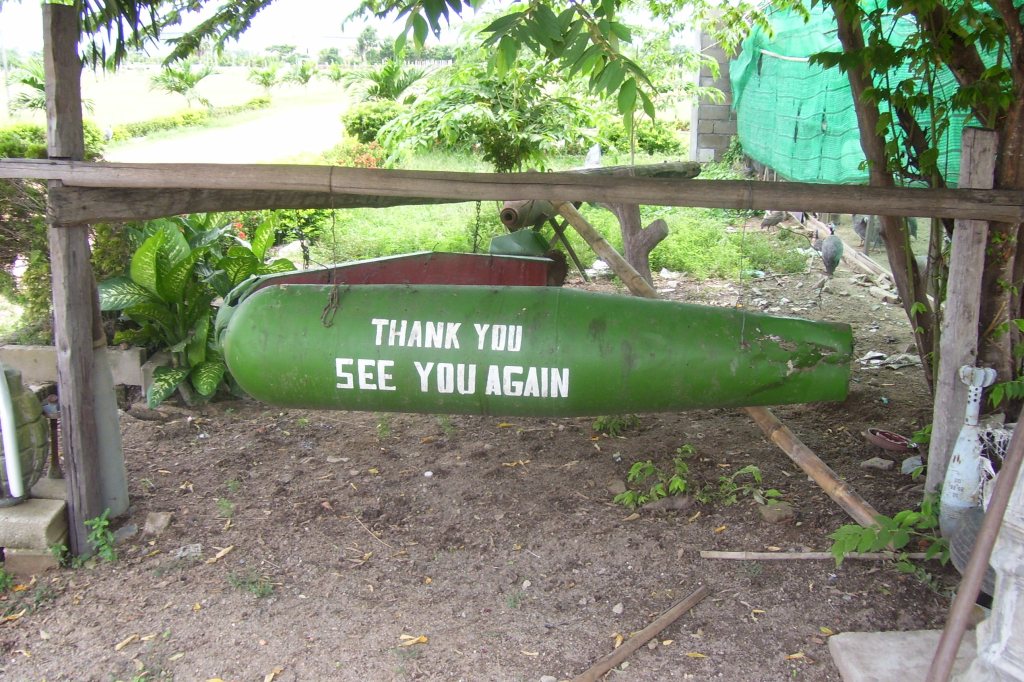
I discovered this unusual sign at a shooting range in Siem Reap, Cambodia. The message on it is simple enough – thanking clients for their visit and hoping to see them again – but the fact that it has been written on the side of a bomb left over from the genocidal war that took place during the Pol Pot regime of the 1970s makes it quite extraordinary. Even so, it’s nice to see someone has found an alternative use for it now. Interestingly, the guns and ammunition on the shooting range are also left over from the war in Cambodia. Nowadays, it is the tourists who use them, eager to feel the adrenalin rush of firing live ammunition from a machine gun. During my visit, I discovered what it was like to pull the trigger of an AK-47 and it wasn’t long before I had emptied my entire cartridge in a smoke-filled shooting gallery. With every shot, I could feel the heavy jolt of the gun vibrate through my body and, even with ear defenders, the noise was absolutely deafening. It was an experience that was as terrifying as it was exciting and it’s not one that I’ve ever had the urge to repeat since.
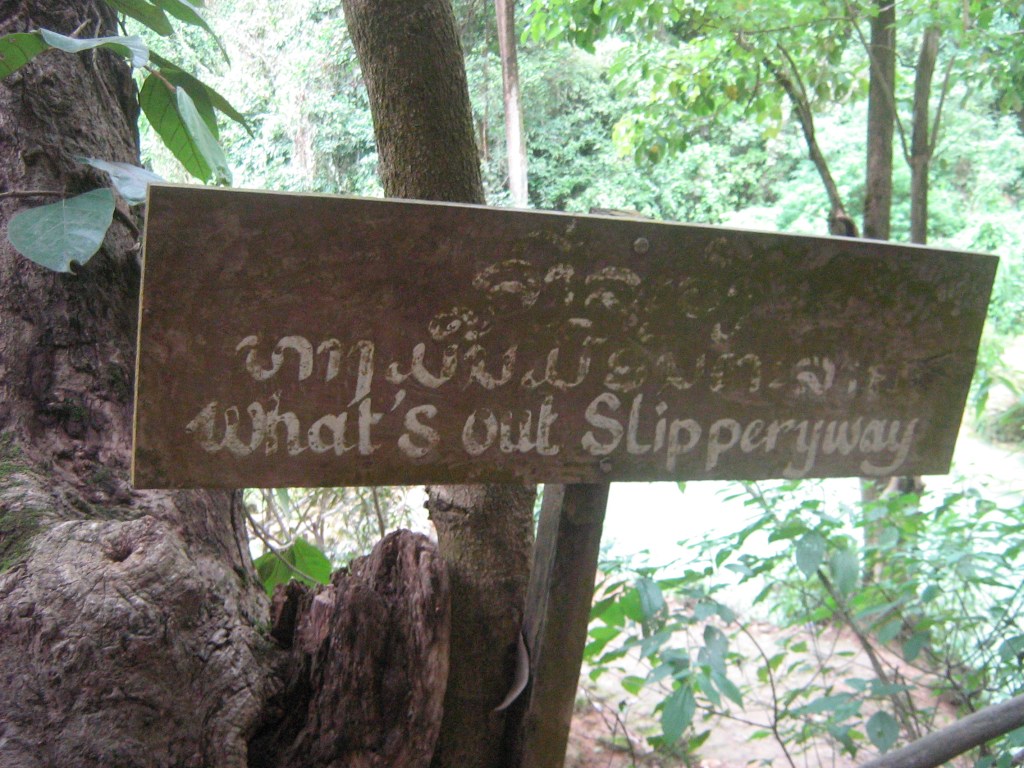
I discovered this sign whilst out and about on my motorbike in Laos, on my way to visiting a waterfall. Above, there is something written in Lao and underneath this, the warning ‘What’s out Slipperyway’ can be made out in English. You can understand what the message is trying to convey so, in that respect, it’s a valiant effort by the makeshift translator who came up with it. However, the use of English is hardly flawless and you can see straightaway that ‘watch out’ has been muddled up with ‘what’s out’, presumably because they sound very similar. You can also decipher why a non-native might have plumped for the word ‘way’ but an English speaker would instantly know that ‘path’ sounds much better. Therefore, an improved version would read: ‘Watch out, slippery path’.
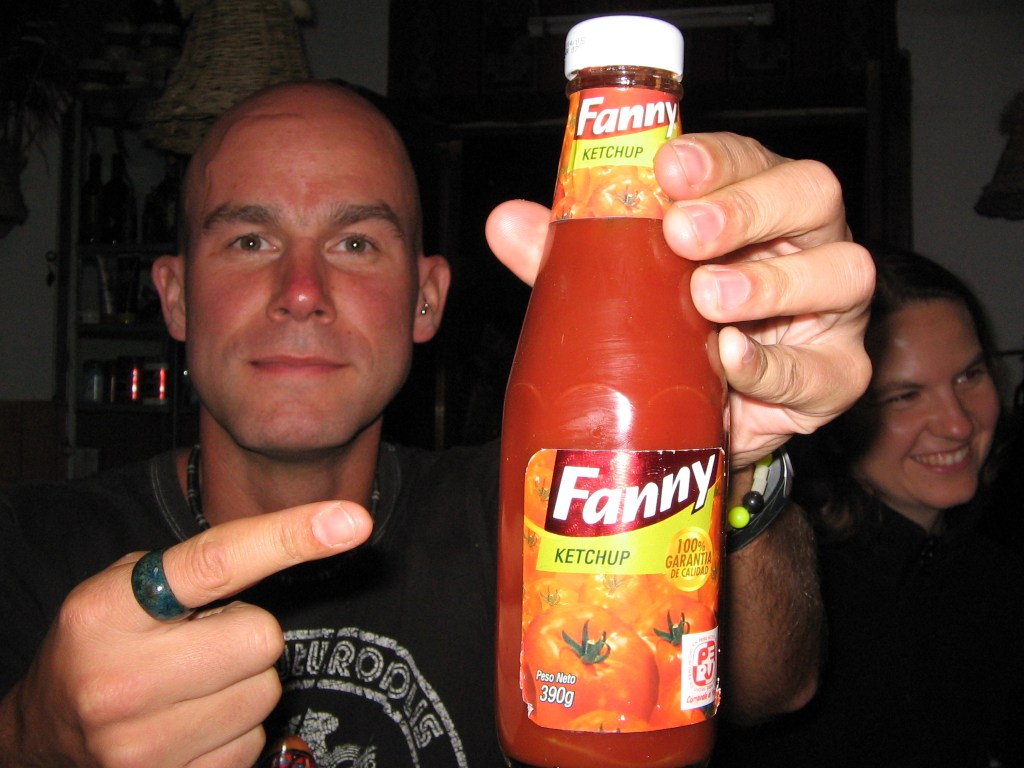
Here is a photo of myself clutching a bottle of ‘Fanny Ketchup’ in Peru. Whilst in the Spanish-speaking world this is a perfectly acceptable name for a brand of ketchup, in the UK it is problematic on so many levels. The issue is that ‘fanny’, an old-fashioned girl’s name, is also a commonly used slang term for female genitals. This means that when you see a bottle full of thick red liquid with the label ‘Fanny Ketchup’ on it, it isn’t long before you start thinking of another red substance related to the fanny zone which, in turn, can put you right off your lunch, especially if it has just been covered in Fanny Ketchup. On a side note, in North America, the word ‘fanny’ is used to refer to someone’s bottom rather than their vagina. Naturally, this can lead to considerable confusion and you need to be extremely careful when engaged in fanny-based chit-chat with someone from that neck of the woods. For example, imagine if you were in conversation with an American gentleman and he suddenly said to you, ‘Look at her big fat fanny’. You would immediately be thinking of something completely different to him and it wouldn’t be until you turned round that you realised he was referring to the big girl’s huge bottom who just walked by. And don’t get me started on bum bags and fanny packs!
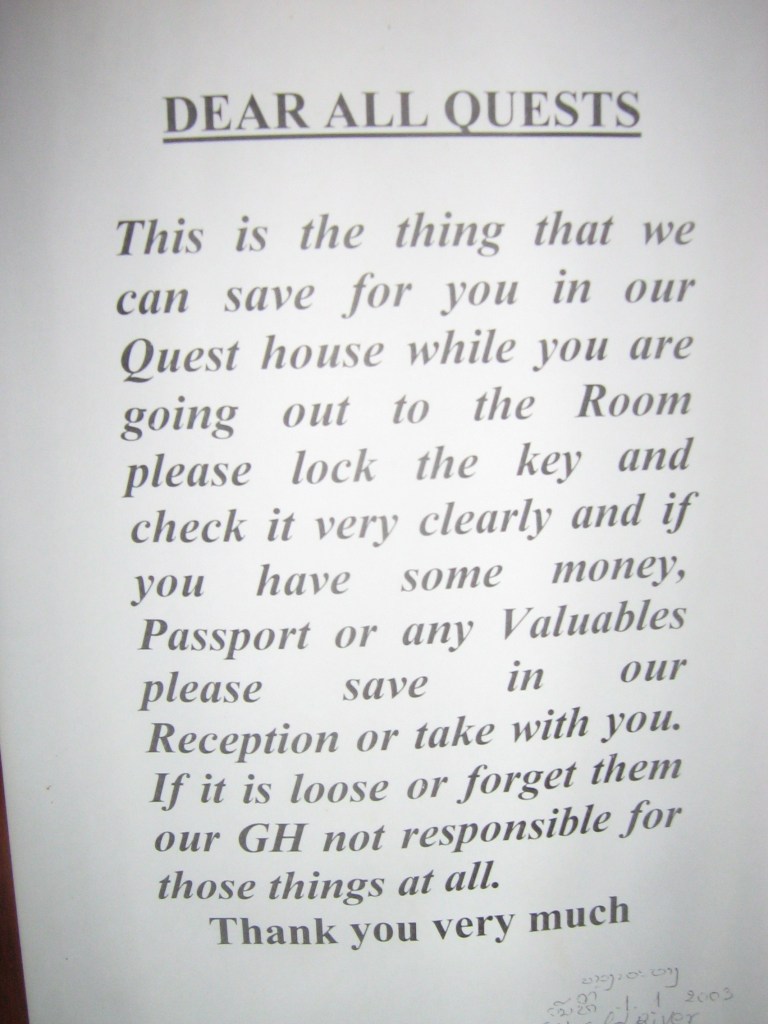
I came across this beautifully written piece whilst staying at a ‘Quest house’ in Vang Viang, Laos. I’m sure you will agree, if there was such a thing as verbal diarrhoea in written form, this is exactly what it would look like. Instead of getting to the point, it spouts a cacophony of jibba jabba that is wrong on so many levels. I’m no Charles Dickens, but if I fancied turning this splattering mish mash into something resembling half-decent English I might go with: ‘FOR THE ATTENTION OF ALL GUESTS – Please lock your door when you leave your room. Take passports, money and any other valuables with you or leave with us at reception for safekeeping. The guest house is not responsible for anything you leave in your room. Thank you.’
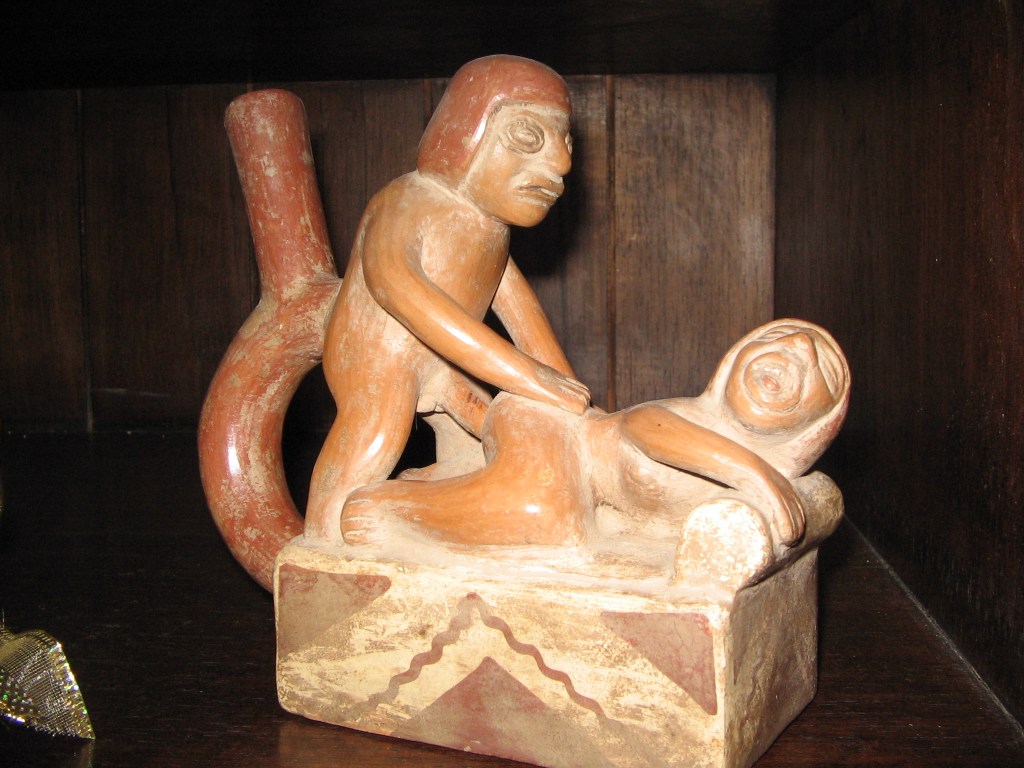
As someone who led a very sheltered childhood, I’m not quite sure what is going on here! Although this blog post is only supposed to be for signs, I couldn’t resist slipping this one in (it appears Backscuttle Barry couldn’t either by the looks of it). I came across this statue whilst staying at a hotel in Peru. Leaving nothing to the imagination, I couldn’t get over the fact that such a naughty piece of art was casually on display in the hotel’s foyer for all to see. At least they both look like they’re enjoying themselves, which is the main thing I suppose.
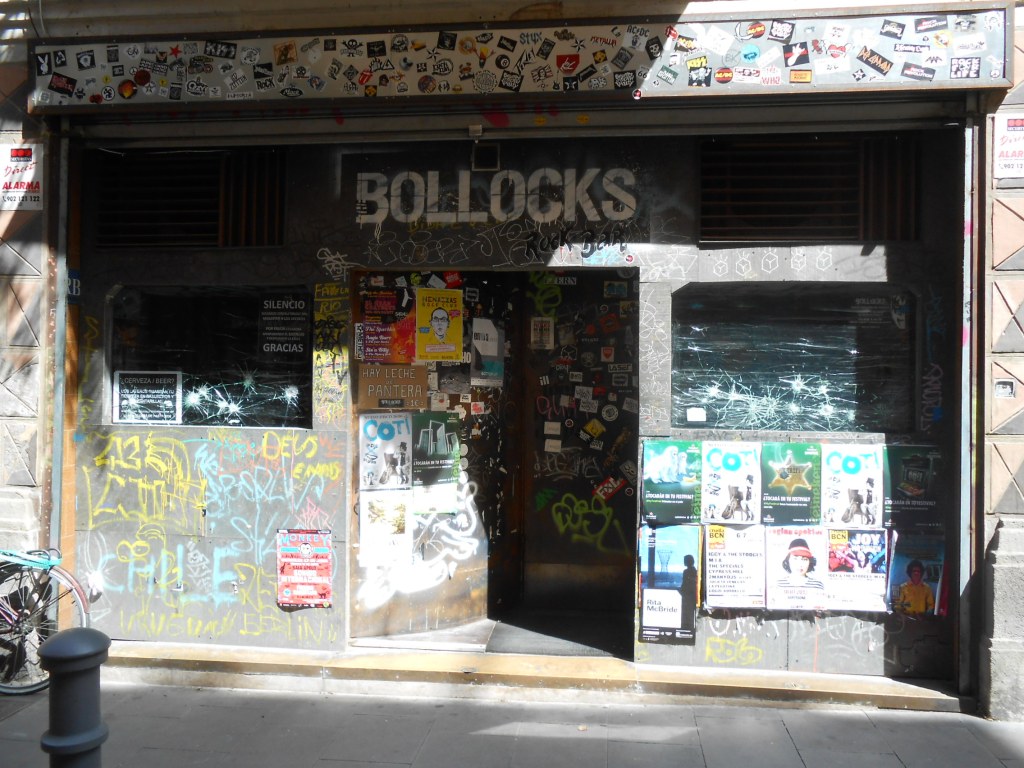
I spotted this establishment whilst walking around Barcelona in Spain and, since I’ve always been a big fan of the word on the sign, it naturally caught my eye. A slang term to refer to testicles, ‘bollocks’ is a versatile word that can also be used to express disagreement. For example, if you are in conversation with someone and you believe what they are saying is nonsense, you can tell them they are talking ‘complete bollocks’. Furthermore, it can also be used as an exclamation of annoyance so if you accidentally spill a glass of red wine down your white shirt you may wish to say, ‘Ah bollocks!’ Curiously enough, when ‘bollocks’ is added to ‘the dog’s’ to form ‘the dog’s bollocks’, you end up with a very handy expression used to say something is extremely good. For example, if sliced bread really rocks your boat, you might like to say, ‘Sliced bread is the dog’s bollocks’. You may wonder why the expression avails itself of the dog’s and not some other animal’s bollocks. The answer is unclear, but together with ‘the cat’s whiskers’ and ‘the bee’s knees’, it’s not the only nonsense term used to describe something as being excellent.
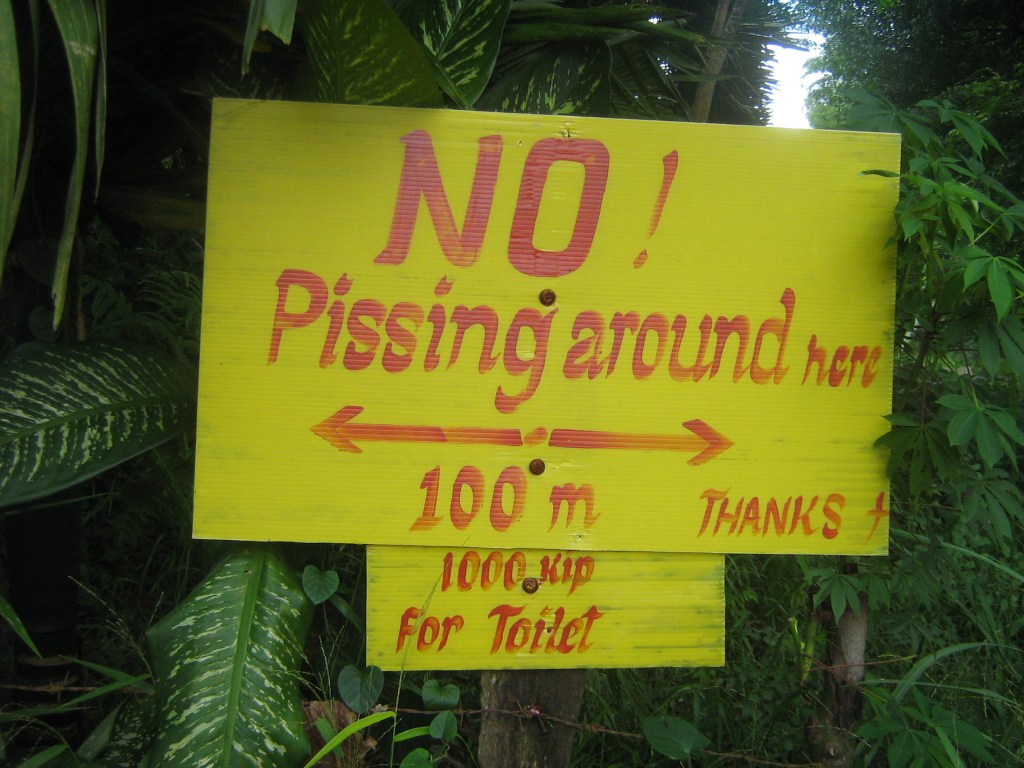
I stumbled across this wonderful sign whilst in Luang Prabang, Laos, just before going tubing down a river. Brave, bold and straight to the point, it cuts out all the bollocks (see previous photo) and leaves you in no doubt that there will be absolutely ‘No pissing around here!’ Indeed, if you do need to empty your bladder it tells you exactly how far you need to walk and in which direction you need to go before you can relieve yourself. Conveniently, it also gives you the option to use a toilet instead, all for the sum of 1000 kip which, back when the photo was taken, was the equivalent to a few pence. This reminds me of the expression ‘spend a penny’ which is what someone might say if they need to find somewhere to urinate. It derives from the fact that public toilets in the UK during Victorian times required a penny to unlock them. In other words, it meant that if you wanted to ‘spend a penny’, you had to spend a penny.

I chanced on this wee gem whilst strolling around Edinburgh in the UK. It was taken shortly before the Scottish Independence Referendum. In the poster, an old woman is having a good whiff of an envelope that has the ‘Better Together’ slogan on it – the campaign group in favour of maintaining the union – and above it are the words ‘I smell shite’. The ‘shite’ here has a similar meaning to the previously mentioned ‘bollocks’ when referring to ‘nonsense’ and, although the poster is intended to be humorous, it is also a stark warning from those in favour of independence not to be taken in by the words of Better Together. Unfortunately for the leave campaign, not everyone else in the land of whisky and haggis could smell shite, as Scotland voted against becoming an independent country by 55% to 45%.

I spotted this fantastic piece of wall art whilst walking in the Costa Brava, Spain. Although it is a mural rather than a sign, I wanted to include it due to its beauty and simplicity, not to mention the important lesson it bears. The fingertips at the end of a big strong hand can be seen holding on to a plastic bag whilst a gust of wind is trying its best to blow it away. Beside this is a plea to ‘give a hand to nature’. Its meaning is plain enough: keep hold of your plastic bags and rubbish so they can be discarded correctly rather than letting them fly away and damage the environment. In an area where the ecosystem has been ravaged for many years by the growing influx of tourists, hopefully the people who admire this mural will take notice of its simple yet very important message.
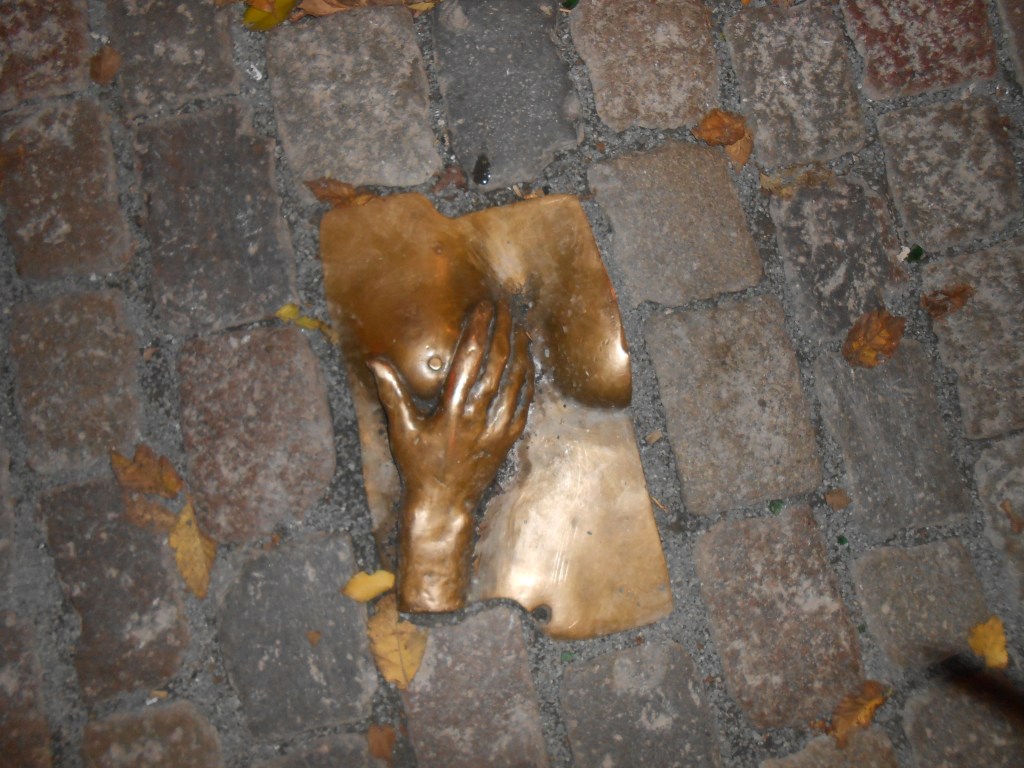
I really couldn’t think of a better way to conclude this blog post than with this random, yet fabulous, brass boob that I came across whilst walking the streets of Amsterdam in the Netherlands. Granted, it’s not a sign but I couldn’t resist including such an intriguing and bizarre piece of art which, I’m sure you will agree, brings a whole new meaning to the term ‘brass rubbings’. It’s not what you expect to see whilst casually walking along the cobblestones of the Dutch capital but, then again, when I recall some of the other things that I saw there, it probably is!


 A Geordie In Girona
Leave a reply to Chris Alexander Cancel reply