
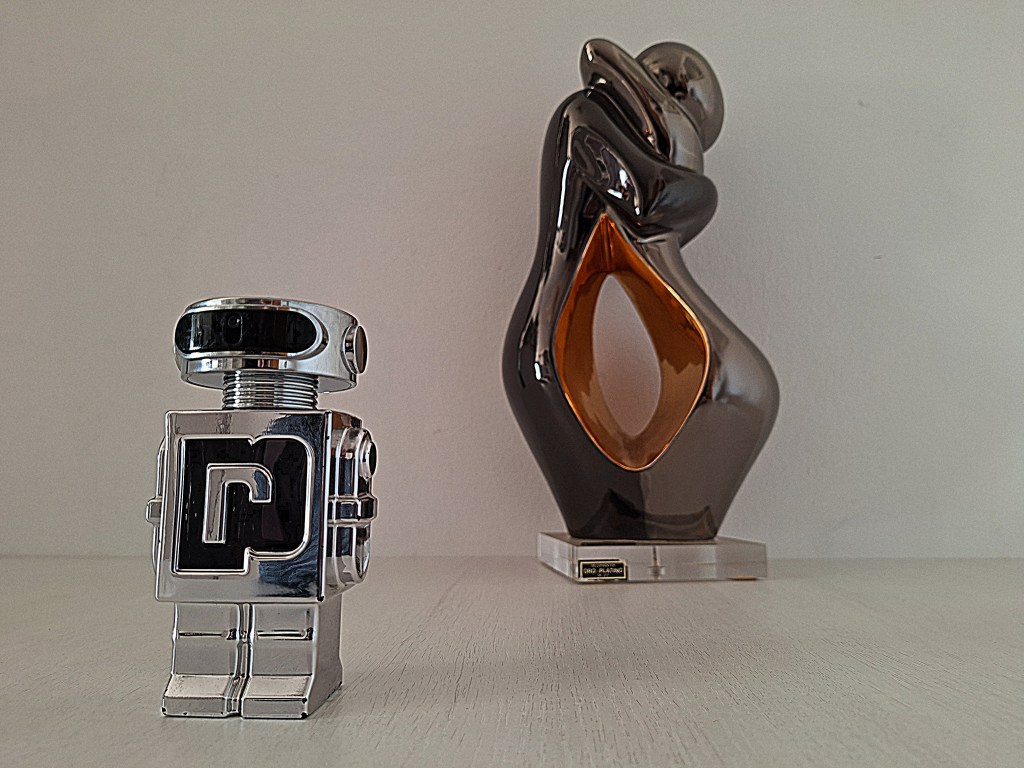
Artificial Intelligence is advancing at an alarming rate, and while many people celebrate it as progress, I can’t help feeling deeply uneasy about where it’s all heading. AI is already reshaping – and in some cases destroying – entire industries, particularly translation, writing and other creative professions. While automation offers speed and efficiency, it also brings job losses, diminished human creativity, and the proliferation of misleading, offensive and low-quality content. The future remains uncertain, but as AI continues to embed itself into every aspect our lives, I look at what the long-term consequences might be. Incidentally, I hope you like the featured image I created for this blog. It shows an ornamental statue of a couple embracing, to represent humanity, with a bottle of Phantom aftershave by Paco Rabanne placed in front of it as a symbol of the robot threat. It perfectly illustrates what this article is all about, and it also demonstrates that with a little ingenuity and thought, humans can still get by just fine without outsourcing every last task to AI.
Google Translate was rubbish 20 years ago
About 20 years ago, after coming back from a year-long trip round the world, I started communicating with an Argentinian girl. We would send each other the occasional email message, but since she couldn’t speak English and I couldn’t speak Spanish, we had to use Google Translate to help us. I would soon discover that the translations being churned out by Google weren’t really up to scratch. In fact, they were sometimes downright bizarre and made little sense. For example, I regularly received messages with the word ‘tapeworm’ in them. From this, I deduced she must have been smoking crack, a belief that stuck with for years until I began to study Spanish and discovered it had never been her intention to nonsensically blabber on about tapeworms at all. You see, the Spanish word for tapeworm is ‘tenia’, whilst ‘tenía’ – with an accent over the ‘í’ like this – is the first- and third-person singular of the imperfect tense of the verb ‘tener’, which means to have. So, the poor girl was actually trying to say ‘I had’ or ‘he/she/it had’, but Google obviously had other ideas, plumping for a translation that would make her look like an absolute mentalist instead.
Another odd phrase that would pop up in her messages was ‘it drinks’. So, for example, she might say, ‘You’re very handsome, it drinks’. Now, under normal circumstances, I would think it strange for someone to keep saying ‘it drinks’ for no particular reason. However, since she was also banging on about tapeworms in a random fashion, I already believed her to be somewhat deranged, so I didn’t think too much of it. Again, it wouldn’t be until a few years later, when I was learning Spanish, that I discovered the poor girl wasn’t off her rocker at all: she was, in fact, trying to be flirtatious. You see, the Spanish word for ‘baby’ or ‘sweetheart’ is ‘bebe’, but, confusingly, it is also the third person singular of the verb beber, to drink, which translates as ‘he/she/it drinks’. So, instead of saying, ‘Oh you’re very handsome baby’, Google took it upon itself to translate it as, ‘Oh, you’re very handsome, it drinks’. There are many other examples I could share, but I think this is enough to illustrate just how buffoon-ridden Google Translate was back in the day.
Machine translation improvements
Since that time, machine translations have improved and evolved greatly. NMT, or Neural Machine Translation, is a type of AI translation that uses deep neural networks to translate entire sentences at once, resulting in more natural and accurate translations than older, word-for-word methods. It learns to translate by studying vast amounts of text, which allows it to capture context and linguistic nuances better. By looking at the whole sentence, NMT can understand how words relate to each other, which helps it resolve ambiguity and produce more fluent, human-like text. When I was studying for my MA in Translation in 2019, the emphasis was all about theory and learning how to put it into practice when carrying out translations. There was very little discussion about AI and machine translation. However, by the time I was working as a translator in 2022, the reality was that technology had already started to adversely affect my new profession. Sadly, this trend would continue to grow right up to the start of summer this year when, due to a lack of clients, I had to give up working as a translator entirely. Basically, AI had robbed me of a career before I barely had a chance to get started in it.
If I were to offer my personal opinion about AI translation, I would say that although it offers a fairly decent translation in less specialised fields, it is still a significant way off yielding the excellent results that a professional translator can. It has to be remembered that it is only a computer and, as a result, cannot think like a human, so it still struggles with things like nuance, style and humour. Therefore, a human is very much still required to edit an automated text to catch any errors and make it sound more natural. Furthermore, with more specialised texts such as those in legal, medical or technical fields, machine translation still fails to cut the mustard and really struggles with the additional complexities involved. That said, the advances in AI translation have been astonishing and are expected to continue. There have been huge investments in the industry, with more and more people working to train and improve artificial intelligence applications. On top of that, there is an ever increasing amount of data – stolen from past translation work – that is being fed through AI databases to improve machine translation output. Since NMT works with translation patterns, the more data fed into the system, the better the results will be. How much better remains to be seen, but as it continues to improve, an ever-growing number of translators will be forced to leave a profession they thought was for life.
Graduates suffering and university courses culled
Of course, it isn’t only the translation industry that is suffering at the hands of AI. I read an article the other day about the difficulties newly qualified accountancy graduates were facing when trying to enter the profession. Apparently, there are far fewer jobs available for them because the big accountancy firms are now using artificial intelligence to do a lot of the work that humans were doing previously. I can well believe this because at the start of the year, I invested in an AI package to help me send invoices and calculate my tax returns. Basically, it did the work I was previously paying an accountant to do. So for the graduates, it is incredibly cruel and unfair. They have invested so much time, effort and money to qualify, only to find themselves entering a career that doesn’t have enough jobs to support them. What is also worrying is that it is likely to create a succession problem; without the required number of graduates coming through, there will be no-one to fill senior positions in the future. This is as true with accountancy as it is with translation, and the same applies to many other professions. It may even lead to professions becoming extinct, not only because the chain of succession has been broken, but also because AI may continue to improve to such an extent that it can handle all work humans are doing.
Naturally, this will impact university courses on a huge scale. Many will be lost as AI continues to do more and more of the work humans once did. It came as no surprise when I heard the MA in Translation course I studied at the Open University is being pulled in the next couple of years. Sadly, there is no point in studying for a career that can’t offer sustainable employment once you’ve qualified. If I had my time again, there would be no way that I would have studied to become a translator. I imagine many of those accountancy graduates are feeling the same, not to mention other graduates across many other fields who have also seen their job prospects completely obliterated by the aggressive advances of AI. Never mind, perhaps we can all go back to university to study a degree in Artificial Intelligence as that should promise plenty of job opportunities – well, until we have taught AI how to automatically improve and programme itself anyway.
AI waitresses
I visited a Japanese restaurant in Girona the other week. A young waitress showed us to the table. There was no greeting, no smile or indeed any form of conversation from her. I tried to speak to her, asking how she was and also thanking her for the menu she plonked down in front of us. She just ignored me and walked off, but not before giving me the kind of look you might expect to receive off someone had you just shat heavily all over their car windscreen. I would have got up and left the place, but then I remembered I was in Spain where it is not unheard of to receive poor service, plus I was hungry. Anyway, a while later, the most amazing thing happened: a robot – not dissimilar in appearance to Metal Mickey – appeared at our table with the food we had ordered. Politely, she instructed us to “Please take the food off the tray,” before then going on to say, “Thank you. I hope you enjoy your food”. Flabbergasted, it wasn’t long before I was comparing the friendly service from my AI waitress to the disgraceful treatment I had received from the human waitress when we had first arrived. Looking back, the human waitress probably had such a sour face because robots were on the verge of taking her job from her. All the same, it was slightly worrying to think that the AI robot was actually better at doing her job. It wasn’t just her manners I was impressed by either; her mobility was also very good. She moved on tiny wheels and was programmed so that when she brought the food, she didn’t bump into any other tables. She was also fitted with sensors so that she would stop and go around any humans that happened to cross her path. Although pretty amazing, it was unsettling for me to think just how quickly technology was advancing. If we now had robot waitresses, I wondered what would be next.
AI interpreters, voice artists and presenters
Another AI-related advance I’ve seen is an app you can speak into which instantly recognises what you’ve said. It can then be programmed to say what you’ve just said in any other language that you wish. Furthermore, with the use of voice recognition, it can use your actual voice to say whatever it is that you want to say in any other language. So if you’re on holiday in Japan, for example, and you’re in a restaurant, you can ask the waiter what dishes there are with chicken in them. You would simply speak into the app and then it would instantly translate and ask the question in Japanese with your own voice. Although the technology still needs to improve before it is anywhere near flawless, it will most likely lead to a diminishing need for interpreters over time. Similar technology also allows you to do corporate videos. You may wish to do a sales video for air conditioning, for example. You could submit what you want to say in a video talking about the product. Then if you want to sell your product to China or Germany, AI could be used to then take your voice and make you speak Chinese or German in a sales video. It would still be you in the video and your mouth will be moving, but it will be in sync to the different languages you have been programmed to talk in. What’s more, if you didn’t want to be in the video, AI would allow you to create a different person to present the video for you. Using similar technology, AI-generated newsreaders could be used to present the latest news in any language, and a new AI Match of the Day presenter could be created to present the weekly football action (it could even be programmed to stay impartial at all times, unlike Gary Lineker). As the technology gets even better over time, it could see an end to TV presenters altogether.
AI authors, copywriters and editors
I’ve been writing a book – you can find more information about it by clicking here – since March 2024. Given that it has consumed an incredible amount of my time and energy since I began the book-writing process, you can probably appreciate just how upset I was to learn that AI can now write books for you in an incredibly short period of time. All you have to do is tell an app like Chat GPT what you want the book to be about by giving some detail about the plot, characters and setting, for example, and hey presto it will write an entire book for you in a matter of hours. It will not only write books for you but also any other publications, such as articles, blogs, poems and short posts for social media sites like LinkedIn. Although the quality is questionable – just like it is when it comes to everything else AI is involved with – it is expected to improve over time, which will adversely affect the futures of writers, editors and anyone else involved in publishing. Who will require copywriters, editors or proofreaders when you can get AI to do it all for you?
You may wonder how all this is even possible. Well, it’s all down to Chat GPT and similar apps. GPT stands for Generative Pre-Trained Transformer. This means that it learns what to say by capturing information from the internet. It then uses all of this text to ‘generate’ responses to questions or commands that someone might ask. Released in November 2022, it is a generative artificial intelligence chatbot developed by OpenAI. It isn’t the only AI chatbot: Google has announced its own one launching soon called Bard; Meta, which owns Facebook, WhatsApp and Instagram, launched its version called Blenderbot in the US last year; and there’s also a Chinese version called Ernie, created by company Baidu. Amazon is also upgrading Alexa with its own advanced AI, inspired by ChatGPT, for more natural conversations. Chat GPT gets its information from a large number of texts from the internet, including articles, X (formerly Twitter) and the whole of Wikipedia. It is also trained on a large volume of books and constantly improved through conversations with human trainers. Although Chat GPT is still prone to writing incorrect or nonsensical answers from time to time – commonly known as AI slop – the belief is that, on the whole, it produces decent results that will only get better with time. I just hope I can get my book written and make some sales from it before these bloody computer bots are writing flawless books that authors like myself can no longer compete with. Because if they’ve got access to the entire works of William Shakespeare, Charles Dickens and William Wordsworth at their fingertips, I doubt I’ll stand a chance. I mean, I’m very good, but I’m not that good. In fact, I don’t even know why I’m sat here writing this blog now. I could have just got Chat GPT to write it in seconds, leaving me to sit around with my feet up instead, enjoying a cuppa with a nice Chocolate Hobnob.
AI is the nemesis to human creativity
Machines helped Britain grow the biggest and most powerful empire the world has ever seen. However, machines also took the creativity out of many hand-crafted processes, leaving many workers on the scrapheap. Today, creativity is suffering again. One example of a creative industry being hit hard by AI is fashion. AI-generated models are taking the place of human models in fashion shoots, which impacts the jobs of not only the models themselves, but also the hairdressers, the make-up artists and the photographers. It also means that large amounts of money no longer need to be spent on sending a crew on a fashion shoot to the Seychelles or some other exotic location, because AI can now not only generate a beautiful-looking fashion model, dress her in the clothes you want to sell, and do her hair and make-up, but it can also generate beautiful locations for the model to appear in. Music is another industry that could be hit hard. With a few prompts from its user, AI has the ability to write new songs and add lyrics to it. It can even write classical music to appear in particular film scenes, so composers and the musicians from entire orchestras could be out of work. Teaching is another profession that could be hit hard. You can now use apps to learn many subjects. Babble, the language learning app, evaluates you with ongoing assessments, so it can provide tailor-made classes to help you overcome weaknesses and improve your language skills. It will even pick up on any pronunciation errors and help you correct them. It does make you wonder which jobs will be safe in the future when the technology gets even better. I suppose the only jobs that might not be so affected would be those involving manual labour, such as builders, gardeners and plumbers. However, if they can create robots that can replicate us not only mentally but physically as well, who knows what will happen.
Social media swamped by AI
There used to be that famous saying ‘A photo never lies’. If you saw a picture of something you always believed it to be a true reflection of reality, but this just isn’t the case anymore. Let’s say a private investigator handed my partner a photo of me snogging someone – Countdown’s Rachel Riley, for instance – I could simply deny it ever occurred, explaining that it had obviously been maliciously created by AI instead. Nowadays, when you look on the Internet and social media – particularly Facebook – it is riddled with artificial intelligence. You just don’t know what’s real and what’s fake anymore. For example, at the start of the football season, I regularly see Facebook posts stating that someone has signed for Newcastle United, the club I support. These posts are accompanied by pictures of the player in a black and white Newcastle shirt. When this trend began a few years ago, I actually believed these posts to be true. However, over the course of time, I’ve learnt to take them with a pinch of salt, knowing that they have more than likely been made with AI. Of course it’s not just photos that are fake; you can even get apps to make videos for you. All you have to do is describe what you want, and it will create the video. This could be somebody riding on the back of a crocodile or even getting eaten by a shark – anything really. You can even make it about someone you know by providing AI with an image of the person, which will then transfer them to any scenario your twisted imagination comes up with.
Famous people are also very popular targets, as you might imagine. I’ve seen videos of Prince William doing ‘The Macarena’ with his wife and children. Although, at the moment, you can still tell it’s fake, the technology is only going to keep on improving, making it far more difficult to tell it apart from reality further down the line. Even though many of these videos may just seem to be a bit of fun, they can have very negative consequences for the people close to the person staring in them. For example, someone had made some AI videos of Robin Williams. In the videos he is talking and going about his life as though he were still alive today. His daughter was interviewed about it on the news and explained how deeply upsetting such videos had made her feel. I have also seen a distasteful video of Stephen Hawking, the famous scientist who spent much of his life in a wheelchair suffering from motor neuron disease. In the AI video, he was about to be arrested by the police, but before they had the chance to place him in handcuffs, he suddenly got out of his wheelchair and ran away. Although this kind of thing is bad enough, I’ve seen far worse and it makes you wonder if there are any controls in place to stop such videos being made, and also to ban them from appearing on social media.
AI virtual girlfriend chat and fake porn
You can now use an app to create the appearance of your own made-up girlfriend. Then you can use the chat to have saucy virtual conversations with her. It’s like Facetime but for desperados. I wouldn’t be surprised if we all had robot girlfriends in the future who we could design ourselves. I’d have a clone of Rachel Riley from ‘Countdown’ with Laura Hamilton from ‘A Place In The Sun’ as a back-up, not that I’ve ever thought about it. In many respects, I can see how having a robot instead of a real girlfriend/boyfriend could probably solve a hell of a lot of problems for many of us. Anyway, I’ve also seen an app where you can make a video of someone kissing any other person, so you can use your face to make the video and choose to be kissing anybody you want. Even more disturbingly, I’ve seen apps where you can actually download a photo of someone and it will make that person naked, allowing you to even alter the size and shape of certain body parts. What is even worse is the growing amount of deep fake porn videos circulating, as well. These are created on an app which allows users to put anybody’s face on a body and have them doing sexual acts with somebody else. This side of AI is deeply worrying – just like most other sides, come to think of it – and it feels that we are now entering very dangerous and dark territory.
AI is making a very small percentage of people very rich
AI has successfully worked its way into every aspect of our lives, it would seem. It is a snowball that just keeps on rolling and getting bigger every day. Every large company throughout the world is investing heavily in it in a bid not to be left behind. But at the end of the day, who is all of this benefitting? I suppose the people who invented AI and the people who are inventing new AI apps are becoming very rich, together with the investors who have invested their money in this industry. But at the other end of the scale, people are losing their jobs and becoming poorer. Take the Masters graduates who toiled away for years to get a qualification that previously was valued and held in high esteem but now is worthless. They certainly aren’t benefitting. Neither are the data entry clerks, the content writers, the historians, the researchers, or even the check-out girls at Tesco, because they’re all slowly becoming unemployed. It seems to be a small amount of people who are making an absolute fortune from AI and they don’t seem to care that they are wiping the floor with humanity. What are we going to do in the future when AI has taken all our jobs and there is no way we can earn money? If Bitcoin keeps on spreading, will there even be money, and would we even need money at all if robots are in charge? Although AI is generally free now, most applications have a paid version which offers better options. Expect this trend to continue on a larger scale in the future as we will see more of the services that are free now becoming paid subscriptions. And the more and more we rely on these services, the more we will be inclined to pay for them. The head honchos pulling all the strings must be aware of this and will be more than happy to tighten the vice when the time comes, giving them more riches and even greater control over the little people.
What will happen in the coming decades?
I remember when I was little, I used to say to my friends, “Wouldn’t it be amazing if one day in the future we had a phone, and instead of just talking on it, we could actually see the person we are speaking to on a screen, as well”. My friends would mock me, telling me that it would never happen. And if I’m being truthful, I never thought it would either, believing it was just my imagination running wild. But of course it has happened, and so many other things have happened too. We have come so far since the days Google was dropping those random ‘tapeworms’ into my translations just a couple of decades ago, and it is scary to think what changes are still ahead of us in the coming decades. If we look at AI today, the results are still generally mediocre – they could be better and they could be worse. More often than not, you are able to tell if something has been created with AI: a photo or video looks fake, a translation sounds unnatural or a written piece of work sounds generic and lacks the author’s personality. However, this doesn’t take away from the fact that the things you can now do with AI are mindboggling. Furthermore, it seems reasonable to expect that AI is only going to keep on improving in the future. In fact, the UK government recently announced that an AI Growth Zone in the North-East is set to unlock more than 5,000 new jobs and bring in £30 billion in investment as the region becomes a hub for AI development. 5,000 shiny new jobs – wow, that’s amazing! Well, it is until it dawns on you that they will be replacing the hundreds of thousands of jobs lost to AI in the future. I was once asked to work for a company called Data Annotation training AI, writing and researching answers and making its performance even better. However, I told them to frig right off. AI has ruined my life and the idea of changing sides made me feel sick to the core – it would be a bit like being an informant for the Nazis in occupied France during the Second World War. Having said that, it may also be the case that working for AI is like getting into one of Titanic’s lifeboats rather than ending up at the bottom of the Atlantic Ocean.
Trying to forecast what will happen in the next few decades is very difficult. I suppose it depends how much AI improves. If it doesn’t get much better than it is now, big companies will eventually come back to humans again because they know AI can’t be relied on. However, if AI has improved even further – which it is expected to as more and more humans are being employed to train and correct it, not to mention the additional data it will have been fed in the next decade which has been stolen from the creative people who will find themselves on the junkpile – there will be little or no movement from big companies to approach humans to come back and work for them. It would also be expected that the number of jobs available will decrease quite dramatically as AI gobbles them all up. On a human level, we will become less able to problem solve and find solutions during difficult moments. We won’t be able to think for ourselves and we’ll become less creative. AI is ideal for people whose catchphrase in life is ‘I can’t be arsed’, and this will become even more the case as more and more of us will become even lazier than we are now. A few of us will end up becoming drivelling wrecks, sat on the toilet asking Chat GPT how to clean our bottoms. We will lose our ability to do research activities. Instead we will ask AI and receive answers in seconds. We will become less resilient and ever so slightly braindead at a time when – due to existential threats to humanity – we really ought to be stronger in order to cope with the new challenges we will face in a world completely swamped by AI.
Are we all doomed?
I suppose there are two main camps when it comes to AI – those who believe it will completely take over from us and those who believe it will never be as good as humans. I’m on the fence, but if I were to give my imagination full carte blanche, I’d be erring in the direction of a complete takeover. At present, the people behind AI want it to eventually be just as good as human intelligence, or even better. If we keep on training AI, correcting its errors and feeding it code, where’s it all going to end? Will it even get to the stage where AI is so intelligent it can train itself, so humans are no longer required to aid its evolution? And what happens if we succeed in developing robots that can mirror humans, both mentally and physically? If this kind of technology were to get into the wrong hands, the capacity would be there to develop robot armies. Who knows, you could end up with a joint Russian and Chinese robot army sent over to destroy Western Civilisation – I wouldn’t put anything past Putin or Xi Jinping, not that I wouldn’t put anything past Trump or Musk either. Even worse, if we make them intelligent enough, they could then start turning on the humans who created them and even wipe out humanity, like we see in these dystopian films. It’s scary, but it could get to a stage where we need somebody like Sarah Connor or Arnold Schwarzenegger from The Terminator to be sent back in time to stop all this from happening in the first place. Having said that, what occurred in the Terminator couldn’t happen in real life because there’s no such thing as time travel. It means that if the robots do take over in the future, we won’t even have Arnie to save us, so we’ll all just die instead!
Even if you forget the dystopic theory of a robot takeover for the moment, there are so many other AI-related disasters that could lead to the demise of mankind and civilisation as we know it. It only takes one spotty-faced computer whizzkid to create some flawless AI video of Donald Trump in which he calls Putin a Russian bellend and tells him he’s going to drop bombs on Moscow. The next thing you know, Putin has retaliated by pressing the atomic button and we’ve all been blown to Kingdom Come. Although I’m writing this in a tongue-in-cheek, worst-case scenario kind of way, none of us really know what will happen further down the line. For me, I find it hard not to imagine our future without a high degree of trepidation. Who really knows what AI will be like in the future? Who knows where it is all going to stop? AI has been billed to supposedly improve our lives and the big tech companies say we are entering a brighter future. However, if AI improves to such an extent that many of today’s professions no longer exist, where will this leave us? As we continue to let AI tighten its grip on our lives, could it be that all we are actually doing is staggering hypnotically into an ever darker future like a bunch of gormless zombies?
If the next stop is dystopia, I only hope my Rachel Riley clone makes it through with me.
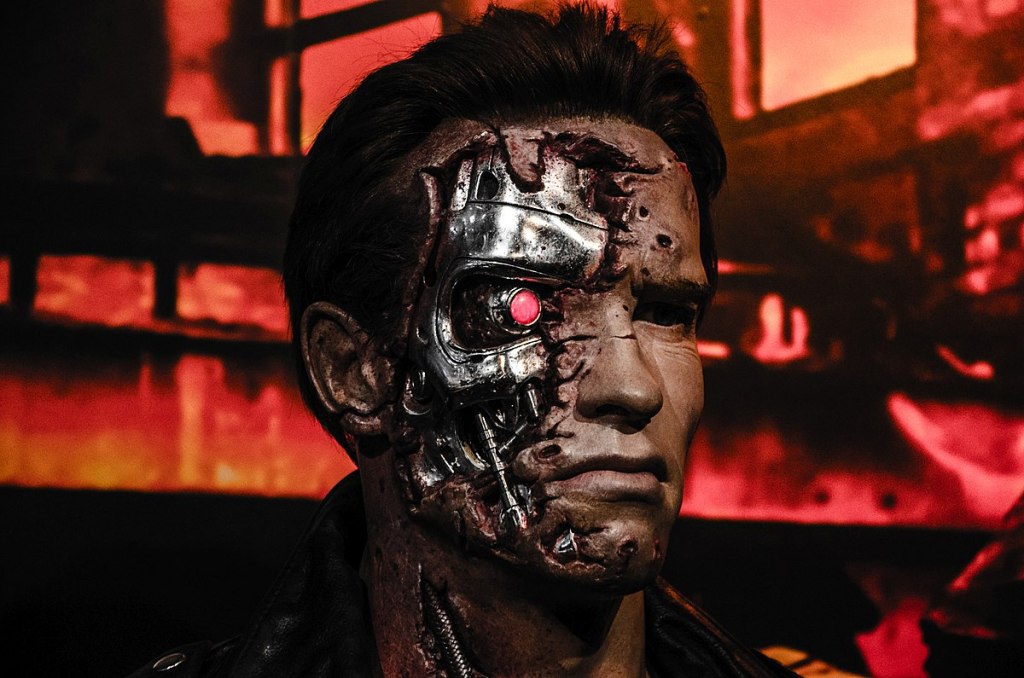
Photo by Daniel Juřena, Wiki Commons, CC BY-SA 2.0


 A Geordie In Girona
Leave a reply to A Geordie In Girona Cancel reply